IMDb >
Shichinin no samurai (1954)
Watch It
Buy it at Amazon
Rent it at
blockbuster.com
Discuss in Boards More at IMDb Pro Add to My Movies Update Data
blockbuster.com
BETA
Discuss in Boards More at IMDb Pro Add to My Movies Update Data
Quicklinks
Top Links
trailers and videosinterprètes et équipe techniqueanecdotesofficial sitesphrases célèbresOverview
infos principalesinfos complètesinterprètes et équipe techniquesociétés de productiontv scheduleRécompenses et critiques
avis des utilisateurscritiques externescritiques des forumsawardsnotes des utilisateursparents guidedans la lignéemessage boardSynopsis et citations
résuméplot synopsismots-clésrésumé du Amazon.comphrases célèbresCuriosités
anecdotesbêtisierinfos B.O.F.clins d'il dans génériqueinfos sur d'autres versionsliens avec d'autres uvresfoire aux questionsAutres infos
en ventebox office/businessdates de sortielieux de tournagecaractéristiques techniquesinfos laserdiscinfos DVDbibliographieNewsDeskMatériel publicitaire
accroches trailers and videos affiches photo galleryLiens externes
horaires dans les sallesofficial sitesdiversphotossound clipsvideo clipsShichinin no samurai (1954) More at IMDbPro »
| Photos (see all 26 | slideshow) | Videos |
Overview
Note des utilisateurs:
Release Date:
19 novembre 1956 (USA) suiteAccroche:
The Mighty Warriors Who Became the Seven National Heroes of a Small TownPlot:
A poor village under attack by bandits recruits seven unemployed samurai to help them defend themselves. full summary | add synopsisAwards:
Nominated for 2 Oscars. Another 4 wins & 5 nominations suiteAvis des utilisateurs:
Complex Beauty suiteEnsemble
(Cast overview, first billed only)| Takashi Shimura | ... | Kambei Shimada | |
| Toshirô Mifune | ... | Kikuchiyo | |
| Yoshio Inaba | ... | Gorobei Katayama | |
| Seiji Miyaguchi | ... | Kyuzo | |
| Minoru Chiaki | ... | Heihachi Hayashida | |
| Daisuke Katô | ... | Shichiroji | |
| Isao Kimura | ... | Katsushiro Okamoto | |
| Keiko Tsushima | ... | Shino | |
| Yukiko Shimazaki | ... | Rikichi's Wife | |
| Kamatari Fujiwara | ... | Manzo, father of Shino | |
| Yoshio Kosugi | ... | Mosuke | |
| Bokuzen Hidari | ... | Yohei | |
| Yoshio Tsuchiya | ... | Rikichi | |
| Kokuten Kodo | ... | Gisaku, the Old Man | |
| Jiro Kumagai | ... | Peasant (as Jirô Kumagai) |
Additional Details
Autre(s) titre(s):
Seven Samurai (UK)Shichi-nin no samurai (Japan) (alternative transliteration)
The Seven Samurai (USA)
Les sept samouraïs (Belgium: French title) (Canada: French title) (France) [fr]
suite
Parents Guide:
View content advisory for parentsDurée:
160 min (international version) | Argentina:163 min | Japan:206 min (initial release) | Sweden:202 min (2002 re-release) | UK:150 min (original version) | UK:190 min (1991 re-release) | USA:141 min | USA:203 min (re-release) | USA:207 min (restored version) | Spain:202 min (DVD edition)Pays:
JapanLangue:
JaponaisCouleur:
Noir et BlancAspect Ratio:
1.37 : 1 suiteSon:
MonoClassification:
Iceland:12 | Portugal:M/12 | Brazil:10 | Czech Republic:U | Spain:T | Argentina:16 | Australia:PG | Canada:G (Quebec) | Canada:PG | Denmark:15 | Finland:K-16 | Norway:16 | Sweden:11 (re-rating) (2002) | Sweden:15 (original rating) | Switzerland:14 | UK:A (original rating) | UK:PG (video rating) (1991) | USA:Unrated | West Germany:16Curiosités
Anecdotes:
Toho pulled the plug on the project several times when it ran over budget, forcing director Akira Kurosawa to go back and personally argue with the board of directors who were convinced they were making a flop. suiteGoofs:
Crew or equipment visible: When the samurai are giving battle advice to the peasants, who sit around them forming a circle, the camera does a rather wide circle shot of them. You can see the dolly track behind the seated peasants. suiteGuillemet:
[first lines]Bandit second-in-command: We'll take this place next.
Bandit Chief: We took it last autumn. They haven't got anything worth taking yet. Let's wait.
suite
foire aux questions
Any recommendations for martial arts movies like "The Seven Samurai"?How much sex, violence, and profanity are in this movie?
Who is the best Samurai?
suite
suite
Message Boards
Discuss this movie with other users on IMDb message board for Shichinin no samurai (1954) suiteRecommendations
If you enjoyed this title, our database also recommends:
Show more recommendations
|
|
|
|
|
| The Last Samurai | Yojimbo | Mononoke-hime | Ying xiong | Rashômon |
|
IMDb Note des utilisateurs:
|
IMDb Note des utilisateurs:
|
IMDb Note des utilisateurs:
|
IMDb Note des utilisateurs:
|
IMDb Note des utilisateurs:
|
Related Links
| Full cast and crew | Company credits | External reviews |
| IMDb top 250 movies | IMDb Action section | IMDb Japan section |
| Add this title to MyMovies |


Donald Richie thought it was Kurosawa's finest, and suggested that it might the best Japanese film ever made.
It is a film that rewards casual viewing and careful viewing and repeated viewing and viewing over time. Isn't that rather like a wonderful book, that rewards you every time you pick it up? I suppose that is the definition of greatness.
How was this greatness achieved? (This is not a rhetorical question. It truly astonishes me how this film creates meaning...cutting across all boundaries of nationality, language, and culture to become a meaningful personal experience for those who view it). This creation of greatness may be a mystery, but we can point to the some features of the film's excellence:
The artistic achievement: The music, the cinematography, the extensive set design, the editing and the acting in the service of a moving story all conspire to create a world that becomes ours on a deeply personal level. It is a film which influences later films and filmmakers.
The narrative achievement: Based on an original concept of Kurosawa's which began as a "day in the life" documentary of a samurai's existence, Kurosawa developed the idea into this breathtaking film of samurai who save a village. This simple but complexly nuanced human story involves us in different social classes in an historical framework. We come to know individual peasants and samurai, and feel that we know significant things about them, their motivations, hopes and fears.
The achievements of the actors: These are characters you will love, people you need to have in your life: the characters of Kyuzo, Heihachi and the unforgettable Bokuzen Hidari as a bewildered peasant..! Takeshi Shimura, as the leader of the samurai, Gambei, is the embodiment of wisdom, and calm in the storm. And, saying that Toshiro Mifune has star power is like saying the noonday sun sheds a little warmth.
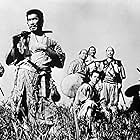
Toshiro: It's the cut of his jawline when he asks the village patriarch, "Got a problem, grandad?", and the most charming look of confusion and embarrassment playing over his face when he is told by Heihachi that he is the triangle on the samurai flag. It's his energy, speed and agility and power and intelligence. Mifune sniffing out the fuse of a gun in the woods, bouncing through the brush half-naked in an abbreviated set of armor, or carrying his ridiculously oversize sword on one shoulder, Mifune crying over a baby, and the incomparable scene of his embarrassment that turns to rage when Mifune accuses the samurai of creating the farmer's condition.
Toshiro Mifune represents with extraordinary physicality the spirit of a man desperate to prove his worth: Mifune's got the animal sexuality, the physical response to emotional situations, the expressive face, the humorous and varied vocalisms to make us feel deeply what his character experiences: his struggles, his growth.(His drunken burblings as the last "samurai" to audition are nothing short of hilarious, and his "fish singing" is eerie and funny, too...also the grunted "eh?" that he often uses to show confusion, and the "heh" of disgust..such wonderful sounds, and so expressive!) Mifune's acting is wild and alive, even more than 50 years after the film's original release.
Takashi Shimura: You will trust him with your life. His great, open heart, his mature calm, his honesty and compassion make him one of the greatest of all samurai on film.
Fumio Hayasaka's music: Kuroasawa was lucky to have such a brilliant composer as collaborator. Themes introduce characters, and the samurai theme is surprising and memorable. If you have viewed the film, chances are, the samurai theme is playing in your mind with just a mention of the music. Hayasaka's music is muscular and nuanced: creating humor, or a counterpoint to the action, or deepening our sympathy for and understanding of the characters.
Muraki's scenography: There is no doubt that the places shown in the film are real. The achievement of Kurosawa's longtime collaborator provide a real world for the action.
The filmography is ground-breaking: the multiple cameras, slow-motion and attention to light and composition make each frame worthy of an 8X10 glossy. How can individual moments of such beauty be sustained throughout the movement of the film? It is an astonishing feat. And, best of all, no image degenerates into interior design or vacuous prettiness...everything forwards the movement of the cinematic experience. When the film ends, we feel as if we have lived it!
It is with great respect and humility that I offer my thanks to the memory of Mr. Kurosawa. His great work leads us to treasure humanity and its struggles, to develop our own abilities to feel compassion, encourages us to try to make good choices, to be socially and morally responsible, to embrace life.